
The Hidden Factory Inside Every Digital Transformation
–
August 13, 2026
Why Legacy Loops quietly consume the value your new technology was supposed to create.
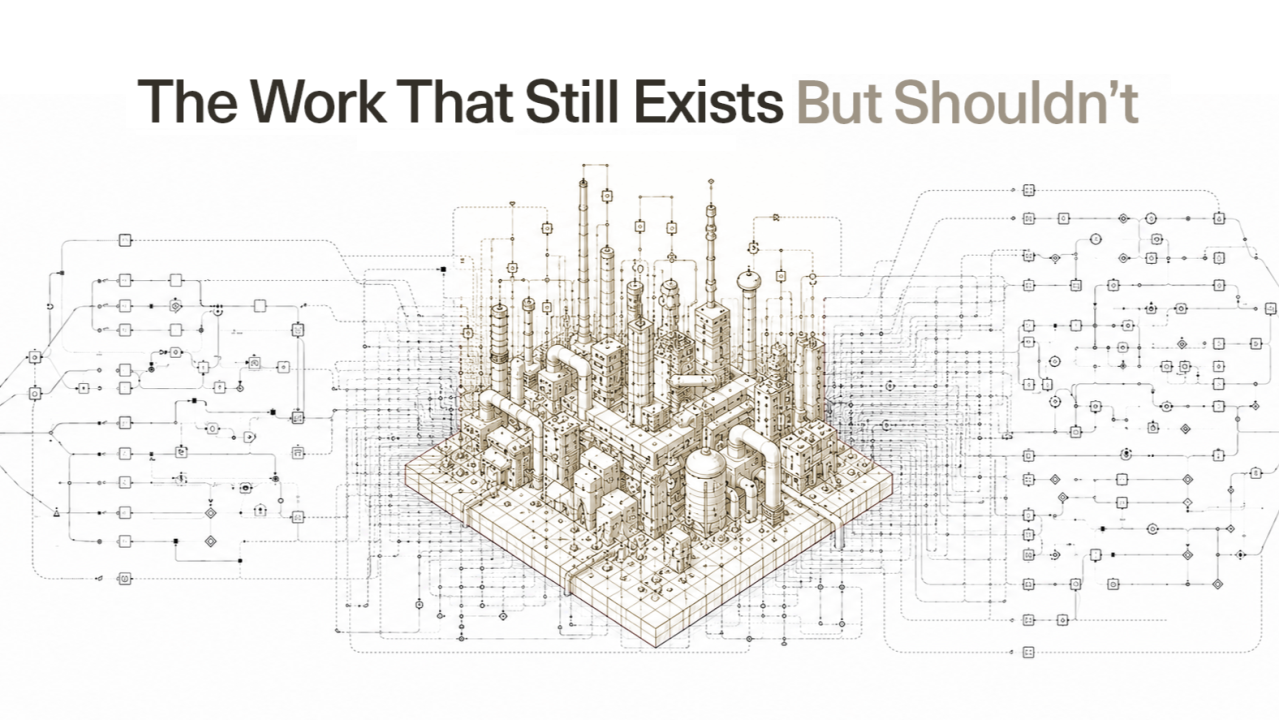
A few years ago, MIT Sloan published an article about something called the Hidden Factory. Although the concept itself dates back much further, it remains remarkably relevant today. The idea is deceptively simple: every organisation has a factory that nobody can see.
It doesn’t appear on the organisation chart. It isn’t part of your SAP programme, your transformation roadmap or your operating model. Yet every day it quietly consumes thousands of hours of productive effort.
The Hidden Factory is made up of work that was never meant to exist. The spreadsheets created because the system doesn’t quite do what people need. The manual approvals that somehow survived the new workflow. The duplicate data entry. The side conversations. The workarounds. The “temporary” fixes that quietly became permanent.
None of these activities appear in the original business case. Yet collectively they consume an astonishing amount of time, effort and ultimately business value.
As I read the article, I found myself nodding along. Not because the idea was new to me, but because it perfectly described the consequence of something I’ve been thinking and writing about for some time.
In my previous article, I introduced the idea of Legacy Loops. The tendency for organisations to implement modern technology while continuing to operate with yesterday’s logic. New systems are deployed, but old behaviours remain. Legacy governance survives. Legacy processes survive. Legacy measures of success survive. In many cases, even the unofficial workarounds survive the transformation itself.
The more I reflected on it, the more I realised that Legacy Loops don’t just reduce the value of transformation.
They create Hidden Factories.
Not overnight, and not through any single decision, but gradually.
Every time someone exports data into a spreadsheet because they don’t quite trust what’s on the screen. Every time a manager asks for a manual report because it’s the way they’ve always reviewed performance. Every time a team invents its own process because “the system doesn’t really work for us.” None of these decisions seem significant on their own. In fact, they often feel entirely reasonable.
But organisations aren’t shaped by one decision. They’re shaped by thousands of small ones.
Over time, those perfectly sensible workarounds become the way work actually gets done. They become accepted. New employees inherit them without question. Managers begin expecting them. Before long, the organisation has created an entirely separate operating model running quietly alongside the one it invested millions to implement.
That’s the Hidden Factory.
Perhaps the most interesting thing about Hidden Factories is that almost nobody sees them.
The people doing the work certainly experience the frustration, but because the effort is spread across hundreds or even thousands of employees, no individual sees the total cost. Leadership sees projects delivered, systems live and adoption dashboards reporting healthy numbers. On paper, everything appears to be working.
Yet beneath the surface, people are quietly adapting the technology to fit the organisation, rather than adapting the organisation to realise the full value of the technology.
Sound familiar?
It also makes me wonder whether we’ve been asking the wrong questions all along.
For years we’ve measured adoption through logins, utilisation, completion rates and training statistics. They’re useful measures, but they don’t tell us whether the business is actually becoming more efficient. They simply tell us that people are using the system.
The more interesting question is this: what work still exists that shouldn’t?
Once you begin looking through that lens, digital transformation starts to look very different. You stop admiring successful go-lives and start asking why people are still manipulating spreadsheets, chasing approvals, re-entering information or maintaining shadow processes years after the new platform was introduced.
That’s where the Hidden Factory begins to reveal itself. Not through one dramatic discovery, but through hundreds of small compromises that have quietly become part of everyday work.
Perhaps that’s why so many digital transformations feel successful at first, only to disappoint a year or two later. The technology hasn’t failed. In most cases it’s doing exactly what it was designed to do. The problem is that the organisation has gradually wrapped layers of old behaviour around it until the promised gains have been diluted.
We tend to think of digital transformation as replacing old systems with new ones. In reality, we’re often replacing old systems while preserving old habits. The software changes, but the operating model quietly carries on as before.
I suspect every organisation has a Hidden Factory. Some are small enough to go unnoticed. Others become so large that they consume a significant proportion of the value the transformation was supposed to create. The frustrating part is that nobody set out to build it. It simply emerged over time, one perfectly reasonable workaround after another.
Reading the MIT Sloan article, I couldn’t help feeling that we’d arrived at the same destination from opposite directions. They describe the Hidden Factory brilliantly. My own work has been trying to understand how those factories come into existence in the first place.
I think the answer lies in Legacy Loops.
They quietly preserve yesterday’s thinking inside today’s technology until those behaviours become normal, accepted and eventually invisible. By the time anyone notices, the Hidden Factory is already up and running.
The challenge for organisations isn’t simply to implement better technology. It’s to recognise when they’re unknowingly rebuilding the past instead of designing the future.
Because once you can see the Hidden Factory, you can finally begin to dismantle it.
Click to read: Why Modern Technology Is Still Managed with Legacy Loops