The Legacy Loops – Why Modern Technology Is Still Managed with Legacy Logic
–
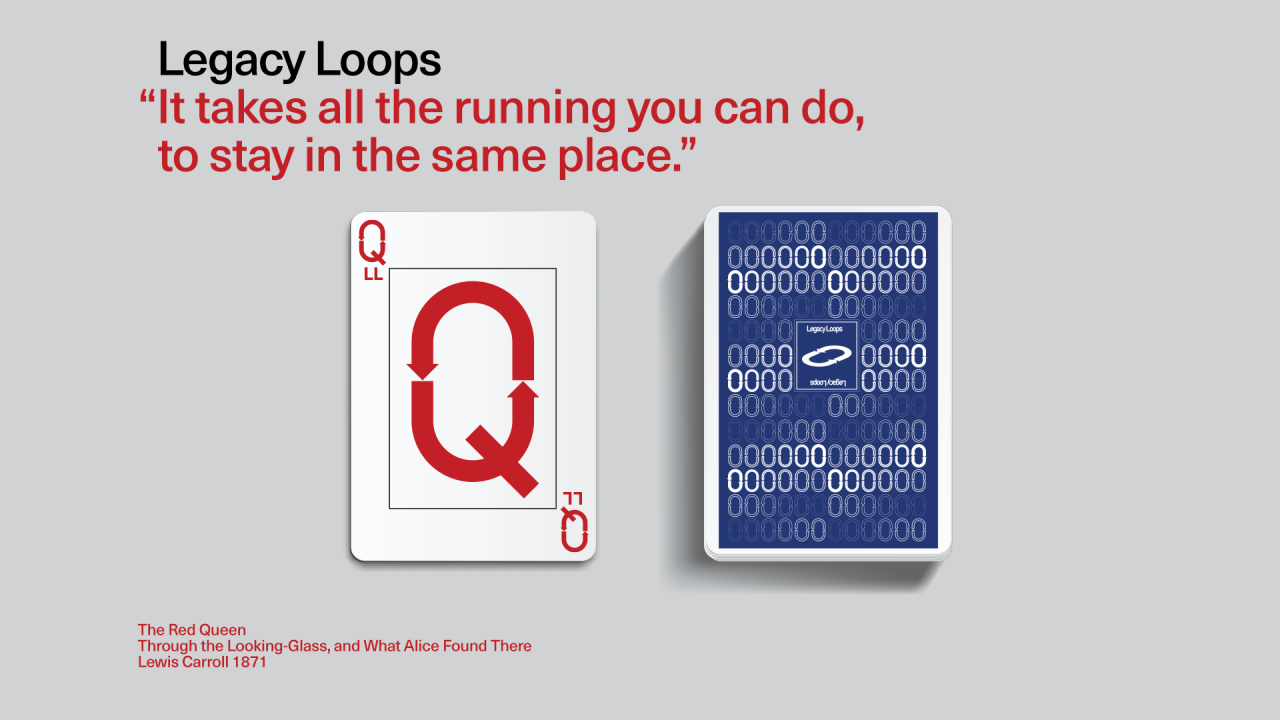
We’re Living in Red Queen Conditions
In evolutionary biology there is a concept known as the Red Queen Effect.
The idea comes from Through the Looking-Glass, where the Red Queen tells Alice:
“It takes all the running you can do, to stay in the same place.”
In highly competitive environments, survival requires constant adaptation. If you stop adjusting, even briefly, you fall behind.
Enterprise technology now operates under these same conditions.
- Cloud platforms update several times a year.
- AI capabilities evolve monthly.
- Automation reshapes workflows continuously.
Technology is no longer static. It is moving all the time.
Yet despite this reality, most organisations still manage adoption as if change happens occasionally.
- A project begins.
- Users are trained.
- The system goes live.
- Then everyone moves on.
That model made sense when technology evolved slowly.
Today it creates a dangerous mismatch between how systems change and how organisations adapt to them.
And that mismatch is where the real problem begins.
–
The Failure That Doesn’t Look Like Failure
Most digital transformations do not fail dramatically. They don’t collapse halfway through implementation. They rarely get cancelled outright and on paper they often appear successful. The system launches, processes are technically operational, and milestones are achieved.
From a programme perspective, everything looks complete, but then something subtle begins to happen. Old habits return and workarounds emerge. Adoption slows. The system is technically live, yet the way people work begins drifting back toward familiar patterns.
Value doesn’t disappear overnight. It simply leaks away, quietly and gradually. Months later the same question inevitably surfaces:
“Why didn’t this transformation land the way we expected?”
–
Naming the Pattern: The Legacy Loops
Inside Digital Adoption Advisor, we describe this recurring dynamic as The Legacy Loops.
The Legacy Loops occurs when organisations deploy modern, continuously evolving technology using outdated, linear models for adoption and enablement. Technology moves forward quickly. Behaviour lags behind.
The result are loop where organisations repeatedly modernise systems while managing them with legacy logic. Once you recognise the pattern, it becomes difficult to unsee.
It appears in ERP transformations, in digital workplace deployments, and in analytics platforms. Different technologies. The same behavioural cycle.
Technology now evolves continuously. Most organisations still support it episodically.
That mismatch creates loops.
–
Twelve Patterns. One System
Legacy Loops rarely appears as a single catastrophic mistake.
Instead, it emerges through a series of small, familiar habits that organisations repeat across transformation programmes.
Inside DAA we have mapped twelve of the most common patterns that quietly undermine digital adoption. What matters most is not the individual patterns themselves. It is how easily they combine into a system.
1. Tool-first loop
Many organisations begin with a tool-first assumption – the belief that purchasing a powerful platform will naturally lead to behavioural change.
Technology is treated as the catalyst, while the conditions required for real adoption are left undefined.
2. Training equals adoption loop
When adoption struggles, attention often shifts toward training.
The assumption is simple: if people have been trained, they should now be using the system correctly. But knowledge transfer does not guarantee behavioural change.
Training creates familiarity. Adoption requires new habits.
3. Project-go-live finish loop
In many transformation programmes, go-live is treated as the moment of success.
The project launches, teams disband, and attention moves elsewhere.
Yet the most important phase of transformation begins only once real work enters the system. Without ownership beyond launch, issues quietly re-emerge and value begins to erode.
4. Hero dependency loop
Within many organisations, a small number of individuals quietly become the people who “really know how the system works.” They solve problems, guide colleagues and keep operations moving. But reliance on these heroes hides a deeper fragility.
Knowledge becomes concentrated rather than scalable.
5. Metrics loop
Value measurement is frequently postponed. “We’ll measure ROI later, once things settle.” In practice, this often means value is assumed rather than proven. By the time organisations begin asking hard questions, adoption patterns are already embedded.
6. Process-only optimisation loop
Transformation programmes often focus on redesigning processes on paper.
The assumption is that if the process is correct, behaviour will follow. But real work happens inside digital systems, where complexity, cognitive load and navigation friction shape how tasks are actually completed.
Beautiful processes can still produce broken execution.
7. Change is someone else’s job loop
Responsibility for adoption often becomes fragmented.
IT delivers the system. Change teams communicate the message. The business is expected to adapt. Everyone participates, yet no single function fully owns behavioural outcomes.
8. Customization comfort loop
When new systems challenge existing ways of working, organisations often revert to customisation. “This is how we work.”
Over time, the system becomes increasingly tailored to legacy behaviour, reducing standardisation and increasing complexity with every upgrade cycle.
9. Reactive enablement loop
Adoption support frequently becomes reactive.
Issues are addressed when users complain, rather than proactively identifying friction points in workflows.
The same problems resurface repeatedly, creating a culture of continuous firefighting rather than optimisation.
10. Compliance masking loop
Many organisations rely on compliance metrics as indicators of success. If processes are technically correct, the assumption is that everything is working.
But compliance does not necessarily equal productivity.
Work can follow the rules while still being slow, complex or inefficient.
11. Adoption as a side hustle loop
Adoption responsibilities are often added to existing roles.
Employees are expected to “do adoption” alongside their primary responsibilities.
Without dedicated capability or ownership, adoption work is frequently deprioritised.
Good intentions struggle to translate into consistent outcomes.
12. Legacy mindset loop
Perhaps the most persistent loop of all is the belief that each transformation is different. “This time will be different.”
Yet organisations often approach new technology using the same operating models, governance structures and enablement methods as before.
New systems. Old thinking.
The loop quietly repeats.
–
The Governance Gap No One Owns
At the centre of the Legacy Loop sits something far less visible than technology. A governance gap.
Most organisations have clear ownership for delivering technology.
Implementation teams manage deployment, IT oversees infrastructure and Change teams coordinate communication. But the moment where technology becomes sustained behavioural performance at scale rarely has a clear owner.
The responsibility sits between functions, and what sits between functions is rarely governed. Without governance, adoption becomes something assumed rather than managed, and what isn’t managed rarely compounds into lasting value.
–
In a Red Queen World, Standing Still Is Regression
The Legacy Loop was survivable when change was slow. It is far more dangerous today.
AI co-pilots, automation layers, analytics platforms and modern enterprise systems generate value through continuous experimentation and behavioural evolution.
Configuration alone is not enough.
Users must explore new capabilities. Teams must refine workflows. Organisations must adapt as platforms evolve.
In a Red Queen environment, standing still is not neutral. It is regression.
If organisations continue relying on linear enablement models in a world of continuous technological change, they will find themselves repeating the same transformation journey again and again. New systems will be implemented, but the underlying adoption patterns will remain unchanged.
Until organisations treat adoption as something that must be owned, measured, and continuously managed, they will continue modernising systems while operating with legacy logic. When that happens, the same patterns repeat, the same value leaks, and the same transformation story quietly loops.
–
What Comes Next
In this article we’ve explored the twelve Legacy Loops that quietly undermine digital transformation.
But these loops are not random behaviours. They cluster around four deeper structural weaknesses that repeatedly pull organisations back into legacy thinking.
Over the coming weeks we’ll explore these four failure zones in more detail:
- Technology Assumption Failures
- Adoption Illusion Failures
- Ownership Failures
- Operational Model Failures
Understanding these zones is the first step in breaking the Legacy Loop.
Once you recognise the structure behind repeated transformation failures, you can begin to govern adoption as a discipline rather than hoping it happens naturally.
We’ll explore each of these zones in the upcoming editions of my Digital Adoption Bulletin.
–
